
Explore Podcasts by Region
Discover unique voices and perspectives from podcast creators around the world
All Latest Episodes
Browse all 45048 episodes from all podcasts
-
 Inside Mexico's Decision to Take Down a Drug Lord
From 🇺🇸 The Journal, published at 2026-02-25 21:30
After Mexican authorities killed El Mencho, the country’s most powerful drug lord, his cartel responded with violence across the country. The operation came amid pressure from the U.S. government on Mexico's President Claudia Sheinbaum. WSJ’s José De Córdoba explains the power struggle that will ensue among the cartels and what it means for the global drug trade. Ryan Knutson hosts. Further Listening: - Mexico's New Cocaine Kingpin is Cashing In- Drug Cartels' New Weapon: Chinese Money Launderers Sign up for WSJ’s free What’s News newsletter. Learn more about your ad choices. Visit megaphone.fm/adchoices
-
 SEYI LAW vs ZEKERI IDRIS: Tinubu vs Peter Obi – PART 1
From 🇳🇬 The Honest Bunch Podcast, published at 2026-02-25 20:58
SEASON 8 IS HERE — and we're not holding back. 🇳🇬🔥The Honest Bunch Podcast returns with one of the most explosive conversations we've ever had.In this episode, two powerful voices from opposite sides of Nigeria's political divide go head-to-head:Seyi Law — veteran comedian and vocal supporter of the Tinubu-led governmentZekeri Idris — activist and strong Peter Obi supporter and electoral reform advocateFrom the current state of Nigeria, to governance, the economy, electoral reforms, and the road to 2027, this episode is raw, emotional, and unfiltered.This is not just a conversation.It's a battle of ideologies. A clash of perspectives. A reflection of the Nigerian people.
-
 La Zanzara del 25 febbraio 2026
From 🇮🇹 La Zanzara, published at 2026-02-25 20:45
La Zanzara del 25 febbraio 2026
-
 Milei reforma la Ley de Glaciares: Actualmente se impide la actividad económica en lugares permitidos
From 🇦🇷 Cara o Ceca, published at 2026-02-25 20:43
El senado debatirá este jueves 26 la normativa que redefine la protección del ambiente periglacial para atraer proyectos vinculados a la megaminería y explotación de hidrocarburos. Organizaciones ambientalistas rechazan la iniciativa. "No se trata de cambiar el objeto de la ley, sino de incluir aclaraciones que permitan definir dónde se puede realizar la actividad económica y dónde no. La protección de los glaciares y el ambiente periglacial que cumplan una función hídrica relevante no se va a modificar", dijo en Cara o Ceca Roberto Cacciola, presidente de la Cámara Argentina de Empresas Mineras.
-
 Budget 2026 avoids major tax shocks and Motus posts strong sales and cash-driven interim growth
From 🇿🇦 The Money Show, published at 2026-02-25 18:58
Stephen Grootes speaks to Duncan Pieterse, Treasury Director-general to unpack Budget 2026 in a nutshell. With inflation-linked personal income tax relief, a higher tax-free savings limit, no VAT or corporate tax hikes, and the withdrawal of the planned R20 billion tax increase, Treasury struck a more optimistic tone. However, fuel and carbon levies will rise, the deficit sits at 4% of GDP, and debt is projected to stabilise at 77.3% of GDP. In other interviews, Motus Chief Executive Officer, Ockert Janse van Rensburg discusses Motus’ improved operational performance, the stronger sales volumes across key markets, and how disciplined strategy execution supported the Group’s robust financial results for the period. The Money Show is a podcast hosted by well-known journalist and radio presenter, Stephen Grootes. He explores the latest economic trends, business developments, investment opportunities, and personal finance strategies. Each episode features engaging conversations with top newsmakers, industry experts, financial advisors, entrepreneurs, and politicians, offering you thought-provoking insights to navigate the ever-changing financial landscape. Thank you for listening to a podcast from The Money Show Listen live Primedia+ weekdays from 18:00 and 20:00 (SA Time) to The Money Show with Stephen Grootes broadcast on 702 https://buff.ly/gk3y0Kj and CapeTalk https://buff.ly/NnFM3Nk For more from the show, go to https://buff.ly/7QpH0jY or find all the catch-up podcasts here https://buff.ly/PlhvUVe Subscribe to The Money Show Daily Newsletter and the Weekly Business Wrap here https://buff.ly/v5mfetc The Money Show is brought to you by Absa Follow us on social media 702 on Facebook: https://www.facebook.com/TalkRadio702 702 on TikTok: https://www.tiktok.com/@talkradio702 702 on Instagram: https://www.instagram.com/talkradio702/ 702 on X: https://x.com/CapeTalk 702 on YouTube: https://www.youtube.com/@radio702 CapeTalk on Facebook: https://www.facebook.com/CapeTalk CapeTalk on TikTok: https://www.tiktok.com/@capetalk CapeTalk on Instagram: https://www.instagram.com/ CapeTalk on X: https://x.com/Radio702 See omnystudio.com/listener for privacy information.
-
Milei reforms the Glaciers Law: Currently, economic activity is prevented in permitted places.
From 🇦🇷 Cara o Ceca, published at 2026-02-25 18:31
This Thursday, the 26th, the Senate will debate the regulations that redefine the protection of the periglacial environment to attract projects linked to mega-mining and hydrocarbon exploitation. Environmental organizations reject the initiative. "It's not about changing the object of the law, but about including clarifications that allow defining where economic activity can be carried out and where it cannot. The protection of glaciers and the periglacial environment that fulfill a relevant hydrological function will not be modified," said Roberto Cacciola, president of the Argentine Chamber of Mining Companies, on Cara o Ceca. "The current law has gray areas and prohibits activity in places where economic activity should be allowed, because in those areas there is nothing that affects water resources or feeds rivers, nor are there issues that could alter the flow of glaciers," he added. "What's at stake is the conversion of copper mineral resources in northwestern Argentina, where interpretations can hinder the arrival of investments. Parallel to this, there are enormous projects within the Incentive Regime for Large Investments [RIGI] focused on mining, totaling over 35 billion dollars over a four-year period," he concluded. The advancement of artificial intelligence and its impact on society: "We are facing a weak AI" Fredi Vivas, an Argentine expert in Artificial Intelligence (AI), visited Sputnik's studios and detailed the latest advancements in this field, while also analyzing how it intertwines with daily life. "We are facing a weak AI. As incredible as it seems, it falls within a weak categorization. A self-driving car is good if it drives itself; the same goes for chatGPT, it would be good if no one wrote. AI would be better if it equaled an average human who solves a specific task; this is what Artificial Intelligence aspires to in the future," Vivas explained. "The dangers that this autonomy can bring can be numerous. The most important law developed for AI is in Europe and identifies risk levels in artificial intelligence systems. The highest risk levels would be weapons, health systems. What this law does is audit the algorithms," he added.
-
 JRE MMA Show #174 with Terence Crawford
From 🇺🇸 Joe Rogan Experience, published at 2026-02-25 18:00
Joe sits down with retired boxer Terence Crawford, a three-division undisputed champion who retired 42–0.www.youtube.com/@TBudCrawfordOfficialwww.tbudcrawford.com Perplexity: Download the app or ask Perplexity anything at https://pplx.ai/rogan. Order ALDI on Uber Eats Learn more about your ad choices. Visit podcastchoices.com/adchoices
-
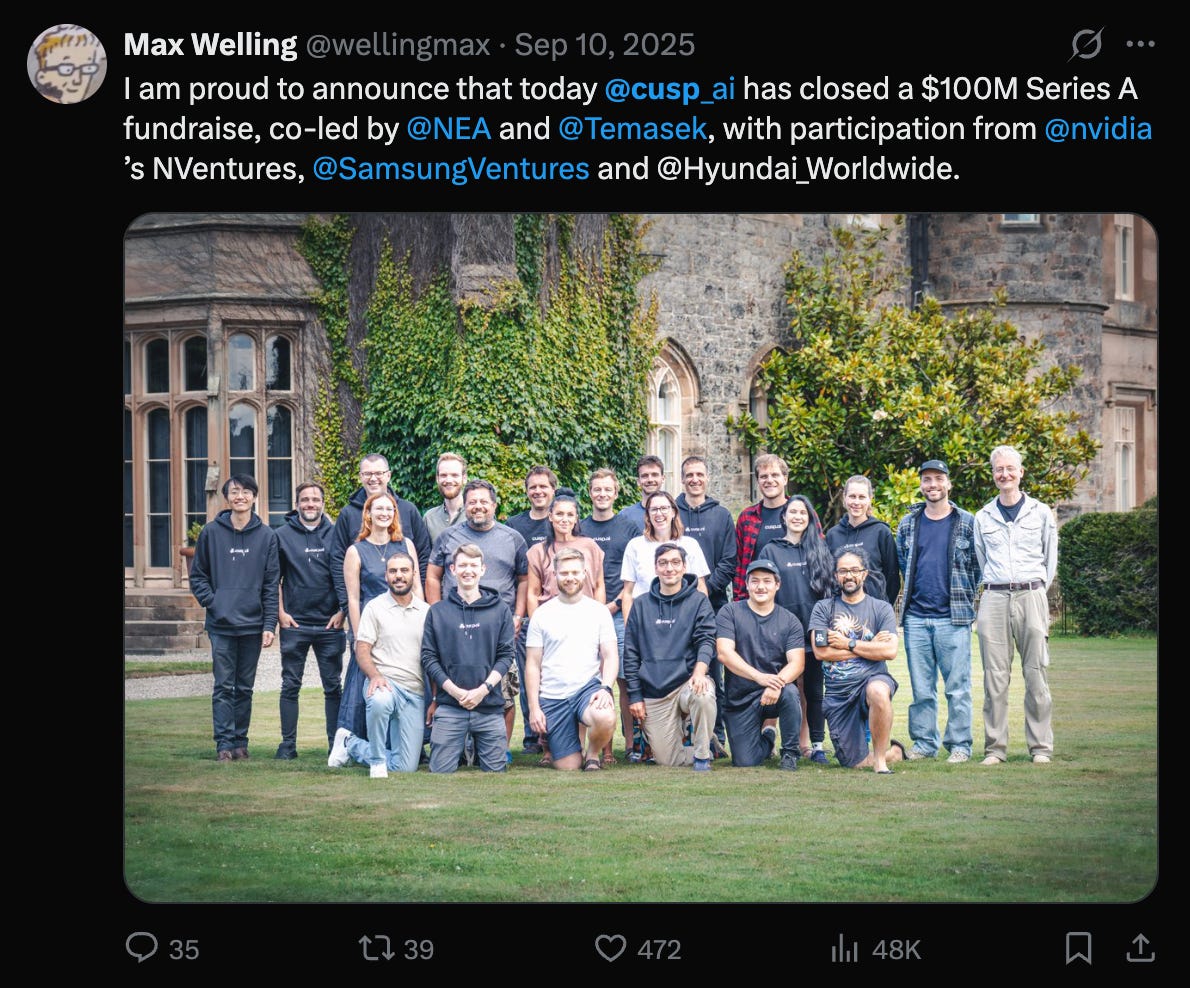 🔬Searching the Space of All Possible Materials — Prof. Max Welling, CuspAI
From 🇺🇸 Latent Space: The AI Engineer Podcast, published at 2026-02-25 17:36
Editor’s note: CuspAI raised a $100m Series A in September and is rumored to have reached a unicorn valuation. They have all-star advisors from Geoff Hinton to Yann Lecun and team of deep domain experts to tackle this next frontier in AI applications.In this episode, Max Welling traces the thread connecting quantum gravity, equivariant neural networks, diffusion models, and climate-focused materials discovery (yes, there is one!!!).We begin with a provocative framing: experiments as computation. Welling describes the idea of a “physics processing unit”—a world in which digital models and physical experiments work together, with nature itself acting as a kind of processor. It’s a grounded but ambitious vision of AI for science: not replacing chemists, but accelerating them.Along the way, we discuss:* Why symmetry and equivariance matter in deep learning* The tradeoff between scale and inductive bias* The deep mathematical links between diffusion models and stochastic thermodynamics* Why materials—not software—may be the real bottleneck for AI and the energy transition* What it actually takes to build an AI-driven materials platformMax reflects on moving from curiosity-driven theoretical physics (including work with Gerard ‘t Hooft) toward impact-driven research in climate and energy. The result is a conversation about convergence: physics and machine learning, digital models and laboratory experiments, long-term ambition and incremental progress.Full Video EpisodeTimestamps* 00:00:00 – The Physics Processing Unit (PPU): Nature as the Ultimate Computer* Max introduces the idea of a Physics Processing Unit — using real-world experiments as computation.* 00:00:44 – From Quantum Gravity to AI for Materials* Brandon frames Max’s career arc: VAE pioneer → equivariant GNNs → materials startup founder.* 00:01:34 – Curiosity vs Impact: How His Motivation Evolved* Max explains the shift from pure theoretical curiosity to climate-driven impact.* 00:02:43 – Why CaspAI Exists: Technology as Climate Strategy* Politics struggles; technology scales. Why materials innovation became the focus.* 00:03:39 – The Thread: Physics → Symmetry → Machine Learning* How gauge symmetry, group theory, and relativity informed equivariant neural networks.* 00:06:52 – AI for Science Is Exploding (Not Emerging)* The funding surge and why AI-for-Science feels like a new industrial era.* 00:07:53 – Why Now? The Two Catalysts Behind AI for Science* Protein folding, ML force fields, and the tipping point moment.* 00:10:12 – How Engineers Can Enter AI for Science* Practical pathways: curriculum, workshops, cross-disciplinary training.* 00:11:28 – Why Materials Matter More Than Software* The argument that everything—LLMs included—rests on materials innovation.* 00:13:02 – Materials as a Search Engine* The vision: automated exploration of chemical space like querying Google.* 01:14:48 – Inside CuspAI: The Platform Architecture* Generative models + multi-scale digital twin + experiment loop.* 00:21:17 – Automating Chemistry: Human-in-the-Loop First* Start manual → modular tools → agents → increasing autonomy.* 00:25:04 – Moonshots vs Incremental Wins* Balancing lighthouse materials with paid partnerships.* 00:26:22 – Why Breakthroughs Will Still Require Humans* Automation is vertical-specific and iterative.* 00:29:01 – What Is Equivariance (In Plain English)?* Symmetry in neural networks explained with the bottle example.* 00:30:01 – Why Not Just Use Data Augmentation?* The optimization trade-off between inductive bias and data scale.* 00:31:55 – Generative AI Meets Stochastic Thermodynamics* His upcoming book and the unification of diffusion models and physics.* 00:33:44 – When the Book Drops (ICLR?)TranscriptMax: I want to think of it as what I would call a physics processing unit, like a PPU, right? Which is you have digital processing units and then you have physics processing units. So it’s basically nature doing computations for you. It’s the fastest computer known, as possible even. It’s a bit hard to program because you have to do all these experiments. Those are quite bulky, it’s like a very large thing you have to do. But in a way it is a computation and that’s the way I want to see it. You can do computations in a data center and then you can ask nature to do some computations. Your interface with nature is a bit more complicated. But then these things will have to seamlessly work together to get to a new material that you’re interested in.[01:00:44:14 - 01:01:34:08]Brandon: Yeah, it’s a pleasure to have Max Woehling as a guest today. Max has done so much over his career that I’ve been so excited about. If you’re in the deep learning community, you probably know Max for his work on variational autocoders, which has literally stood the test of prime or officially stood the test of prime. If you are a scientist, you probably know him for his like, binary work on graph neural networks on equivariance. And if you’re a material science, you probably know him about his new startup, CASPAI. Max has a long history doing lots of cool problems. You started in quantum gravity, which is I think very different than all of these other things you worked on. The first question for AI engineers and for scientists, what is the thread in how you think about problems? What is the thread in the type of things which excite you? And how do you decide what is the next big thing you want to work on?[01:01:34:08 - 01:02:41:13]Max: So it has actually evolved a lot. In my young days, let’s breathe, I would just follow what I would find super interesting. I have kind of this sensor. I think many people have, but maybe not really sort of use very much, which is like, you get this feeling about getting very excited about some problem. Like it could be, what’s inside of a black hole or what’s at the boundary of the universe or what are quantum mechanics actually all about. And so I follow that basically throughout my career. But I have to say that as you get older, this changes a little bit in the sense that there’s a new dimension coming to it and there’s this impact. Going in two-dimensional quantum gravity, you pretty much guaranteed there’s going to be no impact on what you do relative, maybe a few papers, but not in this world, this energy scale. As I get closer to retirement, which is fortunately still 10 years away or so, I do want to kind of make a positive impact in the world. And I got pretty worried about climate change.[01:02:43:15 - 01:03:19:11]Max: I think politics seems to have a hard time solving it, especially these days. And so I thought better work on it from the technology side. And that’s why we started CaspAI. But there’s also a lot of really interesting science problems in material science. And so it’s kind of combining both the impact you can make with it as well as the interesting science. So it’s sort of these two dimensions, like working on things which you feel there’s like, well, there’s something very deep going on here. And on the other hand, trying to build tools that can actually make a real impact in the world.[01:03:19:11 - 01:03:39:23]RJ: So the thread that when I look back, look at the different things that you worked out, some of them seem pretty connected, like the physics to equivariance and, yeah, and, uh, gravitational networks, maybe. And that seems to be somewhat related to Casp. Do you have a thread through there?[01:03:39:23 - 01:06:52:16]Max: Yeah. So physics is the thread. So having done, you know, spent a lot of time in theoretical physics, I think there is first very fundamental and exciting questions, like things that haven’t actually been figured out in quantum gravity. So that is really the frontier. There’s also a lot of mathematical tools that you can use, right? In, for instance, in particle physics, but also in general relativity, sort of symmetry space to play an enormously important role. And this goes all the way to gauge symmetries as well. And so applying these kinds of symmetries to, uh, machine learning was actually, you know, I thought of it as a very deep and interesting mathematical problem. I did this with Taco Cohen and Taco was the main driver behind this, went all the way from just simple, like rotational symmetries all the way to gauge symmetries on spheres and stuff like that. So, and, uh, Maurice Weiler, who’s also here, um, when he was a PhD student, he was a very good student with me, you know, he wrote an entire book, which I can really recommend about the role of symmetries in AI and machine learning. So I find this a very deep and interesting problem. So more recently, so I’ve taken a sort of different path, which is the relationship between diffusion models and that field called stochastic thermodynamics. This is basically the thermodynamics, which is a theory of equilibrium. So but then formulated for out of equilibrium systems. And it turns out that the mathematics that we use for diffusion models, but even for reinforcement learning for Schrodinger bridges for MCMC sampling has the same mathematics as this theoretical, this physical theory of non-equilibrium systems. And that got me very excited. And actually, uh, when I taught a course in, um, Mauschenberg, uh, it is South Africa, close to Cape Town at the African Institute for Mathematical Sciences Ames. And I turned that into a book site. Two years later, the book was finished. I’ve sent it to the publisher. And this is about the deep relationship between free energy, diffusion models, basically generative AI and stochastic thermodynamics. So it’s always some kind of, I don’t know, I find physics very deep. I also think a lot about quantum mechanics and it’s, it’s, it’s a completely weird theory that actually nobody really understands. And there’s a very interesting story, which is maybe good to tell to connect sort of my PZ back to where I’m now. So I did my PZ with a Nobel Laureate, Gerard the toft. He says the most brilliant man I’ve ever met. He was never wrong about anything as long as I’ve seen him. And now he says quantum mechanics is wrong and he has a new theory of quantum mechanics. Nobody understands what he’s saying, even though what he’s writing down is not mathematically very complex, but he’s trying to address this understandability, let’s say of quantum mechanics head on. And I find it very courageous and I’m completely fascinated by it. So I’m also trying to think about, okay, can I actually understand quantum mechanics in a more mundane way? So that, you know, without all the weird multiverses and collapses and stuff like that. So the physics is always been the threat and I’m trying to apply the physics to the machine learning to build better algorithms.[01:06:52:16 - 01:07:05:15]Brandon: You are still very involved in understanding and understanding physics and the worlds. Yeah. And just like applications to machine learning or introducing no formalisms. That’s really cool.[01:07:05:15 - 01:07:18:02]Max: Yes, I would say I’m not contributing much to physics, but I’m contributing to the interface between physics and science. And that’s called AI for science or science or AI is kind of a super, it’s actually a new discipline that’s emerging.[01:07:18:02 - 01:07:18:19]Speaker 5: Yeah.[01:07:18:19 - 01:07:45:14]Max: And it’s not just emerging, it’s exploding, I would say. That’s the better term because I know you go from investments into like in the hundreds of millions now in the billions. So there’s now actually a startup by Jeff Bezos that is at 6.2 billion sheep round. Right. Insane. I guess it’s the largest startup ever, I think. And that’s in this field, AI for science. It tells you something that we are creating a new bubble here.[01:07:46:15 - 01:07:53:28]Brandon: So why do you think it is? What has changed that has motivated people to start working on AI for science type problems?[01:07:53:28 - 01:08:49:17]Max: So there’s two reasons actually. One is that people have been applying sort of the new tools from AI to the sciences, which is quite natural. And there’s of course, I think there’s two big examples, protein folding is a big one. And the other one is machine learning forest fields or something called machine learning inter-atomic potentials. Both of them have been actually very successful. Both also had something to do with symmetries, which is a little cool. And sort of people in the AI sciences saw an opportunity to apply the tools that they had developed beyond advertised placement, right, or multimedia applications into something that could actually make a very positive impact in society like health, drug development, materials for the energy transition, carbon capture. These are all really cool, impactful applications.[01:08:50:19 - 01:09:42:14]Max: Despite that, the science and the kind of the is also very interesting. I would say the fact that these sort of these two fields are coming together and that we’re now at the point that we can actually model these things effectively and move the needle on some of these sort of science sort of methodologies is also a very unique moment, I would say. People recognize that, okay, now we’re at the cusp of something new, where it results whether the company is called after. We’re at the cusp of something new. And of course that always creates a lot of energy. It’s like, okay, there’s something, it’s like sort of virgin field. It’s like nobody’s green field. Nobody’s been there. I can rush in and I can sort of start harvesting there, right? And I think that’s also what’s causing a lot of sort of enthusiasm in the fields.[01:09:42:14 - 01:10:12:18]RJ: If you’re an AI engineer, basically if the people that listen to this podcast will be in the field, then you maybe don’t have a strong science background. How does, but are excited. Most I would say most AI practitioners, BM engineers or scientists would consider themselves scientists and they have some background, a little bit of physics, a little bit of industry college, maybe even graduate school that have been working or are starting out. How does somebody who is not a scientist on a day-to-day basis, how do they get involved?[01:10:12:18 - 01:10:14:28]Max: Well, they can read my book once it’s out.[01:10:16:07 - 01:11:05:24]Max: This is basically saying that there is more, we should create curricula that are on this interface. So I’m not sure there is, also we already have some universities actual courses you can take, maybe online courses you can take. These workshops where we are now are actually very good as well. And we should probably have more tutorials before the workshop starts. Actually we’ve, I’ve kind of proposed this at some point. It’s like maybe first have an hour of a tutorial so that people can get new into the field. There’s a lot out there. Most of it is of course inaccessible, but I would say we will create much more books and other contents that is more accessible, including this podcast I would say. So I think it will come. And these days you can watch videos and things. There’s a huge amount of content you can go and see.[01:11:05:24 - 01:11:28:28]Brandon: So maybe a follow-up to that. How do people learn and get involved? But why should they get involved? I mean, we have a lot of people who are of our audience will be interested in AI engineering, but they may be looking for bigger impacts in the world. What opportunities does AI for science provide them to make an impact to change the world? That working in this the world of pure bits would not.[01:11:28:28 - 01:11:40:06]Max: So my view is that underlying almost everything is immaterial. So we are focusing a lot on LLMs now, which is kind of the software layer.[01:11:41:06 - 01:11:56:05]Max: I would say if you think very hard, underlying everything is immaterial. So underlying an LLM is a GPU, and underlying a GPU is a wafer on which we will have to deposit materials. Do we want to wait a little bit?[01:12:02:25 - 01:12:11:06]Max: Underlying everything is immaterial. So I was saying, you know, there’s the LLM underlying the LLM is a GPU on which it runs. In order to make that GPU,[01:12:12:08 - 01:12:43:20]Max: you have to put materials down on a wafer and sort of shine on it with sort of EUV light in order to etch kind of the structures in. But that’s now an actual material problem, because more or less we’ve reached the limits of scaling things down. And now we are trying to improve further by new materials. So that’s a fundamental materials problem. We need to get through the energy transition fast if we don’t want to kind of mess up this world. And so there is, for instance, batteries. That’s a complete materials problem. There’s fuel cells.[01:12:44:23 - 01:13:01:16]Max: There is solar panels. So that they can now make solar panels with new perovskite layers on top of the silicon layers that can capture, you know, theoretically up to 50% of the light, where now we’re at, I don’t know, maybe 22 or something. So these are huge changes all by material innovation.[01:13:02:21 - 01:13:47:15]Max: And yeah, I think wherever you go, you know, I can probably dig deep enough and then tell you, well, actually, the very foundation of what you’re doing is a material problem. And so I think it’s just very nice to work on this very, very foundation. And also because I think this is maybe also something that’s happening now is we can start to search through this material space. This has never been the case, right? It’s like scientists, the normal way of working is you read papers and then you come up with no hypothesis. You do an experiment and you learn, et cetera. So that’s a very slow process. Now we can treat this as a search engine. Like we search the internet, we now search the space of all possible molecules, not just the ones that people have made or that they’re in the universe, but all of them.[01:13:48:21 - 01:14:42:01]Max: And we can make this kind of fully automated. That’s the hope, right? We can just type, it becomes a tool where you type what you want and something starts spinning and some experiments get going. And then, you know, outcome list of materials and then you look at it and say, maybe not. And then you refine your query a little bit. And you kind of do research with this search engine where a huge amount of computation and experimentation is happening, you know, somewhere far away in some lab or some data center or something like this. I find this a very, very promising view of how we can sort of build a much better sort of materials layer underneath almost everything. And also more sustainable materials. Our plastics are polluting the planet. If you come up with a plastic that kind of destroys itself, you know, after, I don’t a few weeks, right? And actually becomes a fertilizer. These are things that are not impossible at all. These things can be done, right? And we should do it.[01:14:42:01 - 01:14:47:23]RJ: Can you tell us a little bit just generally about CUSBI and then I have a ton of questions.[01:14:47:23 - 01:14:48:15]Speaker 5: Yeah.[01:14:48:15 - 01:17:49:10]Max: So CUSBI started about 20 months ago and it was because I was worried about I’m still worried about climate change. And so I realized that in order to get, you know, to stay within two degrees, let’s say, we would not only have to reduce our emissions to zero by 2050, but then, you know, another half century or even a century of removing carbon dioxide from the atmosphere, not by reducing your emissions, but actually removing it at a rate that’s about half the rate that we now emit it. And that is a unsolved problem. But if we don’t solve it, two degrees is not going to happen, right? It’s going to be much more. And I don’t think people quite understand how bad that can be, like four degrees, like very bad. So this technology needs to be developed. And so this was my and my co-founder, Chet Edwards, motivation to start this startup. And also because, you know, we saw the technology was ready, which is also very good. So if you’re, you know, the time is right to do it. And yeah, so we now in the meanwhile, we’ve grown to about 40 people. We’ve kind of collected 130 million investment into the company, which is for a European company is quite a lot. I would say it’s interesting that right after that, you know, other startups got even more. So that’s kind of tells you how fast this is growing. But yeah, we are we are now at the we’ve built the platform, of course, but it’s for a series of material classes and it needs to be constantly expanded to new material classes. And it can be more automated because, you know, we know putting LLMs in as the whole thing gets more and more automated. And now we’re moving to sort of high throughput experimentation. So connecting the actual platform, which is computational, to the experiments so that you can get also get fast feedback from experiments. And I kind of think of experiments as something you do at the end, although that’s what we’ve been doing so far. I want to think of it as what I would call a sort of a physics processing unit, like a PPU, right, which is you have digital processing units and then you have physics processing units. So it’s basically nature doing computations for you. It’s the fastest computer known as possible, even. It’s a bit hard to program because you have to do all these experiments. Those are quite, quite bulky. It’s like a very large thing you have to do. But in a way, it is a computation. And that’s the way I want to see it. So I want to you can do computations in a data center and then you can ask nature to do some computations. Your interface with nature is a bit more complicated. But then these things will have to seamlessly work together to get to a new material that you’re interested in. And that’s the vision we have. We don’t say super intelligence because I don’t quite know what it means and I don’t want to oversell it. But I do want to automate this process and give a very powerful tool in the hands of the chemists and the material scientists.[01:17:49:10 - 01:18:01:02]Brandon: That actually brings up a question I wanted to ask you. First of all, can you talk about your platform to like whatever degree, like explain kind of how it works and like what you your thought processes was in developing it?[01:18:01:02 - 01:20:47:22]Max: Yeah, I think it’s been surprisingly, it’s not rocket science, I would say. It’s not rocket science in the sense of the design and basically the design that, you know, I wrote down at the very beginning. It’s still more or less the design, although you add things like I wasn’t thinking very much about multi-scale models and as the common are rated that actually multi-scale is very important. And the beginning, I wasn’t thinking very much about self-driving labs. But now I think, you know, we are now at the stage we should be adding that. And so there is sort of bits and details that we’re adding. But more or less, it’s what you see in the slide decks here as well, which is there is a generative component that you have to train to generate candidates. And then there is a digital twin, multi-scale, multi-fidelity digital twin, which you walk through the steps of the ladder, you know, they do the cheap things first, you weed out everything that’s obviously unuseful, and then you go to more and more expensive things later. And so you narrow things down to a small number. Those go into an experiment, you know, do the experiment, get feedback, etc. Now, things that also have been more recently added is sort of more agentic sort of parts. You know, we have agents that search the literature and come up with, you know, actually the chemical literature and come up with, you know, chemical suggestions for doing experiments. We have agents which sort of autonomously orchestrate all of the computations and the experiments that need to be done. You know, they’re in various stages of maturity and they can be continuously improved, I would say. And so that’s basically I don’t think that part. There’s rocket science, but, you know, the design of that thing is not like surprising. What is it’s surprising hard to actually build it. Right. So that’s that’s the thing that is where the moat is in the data that you can get your hands on and the and actually building the platform. And I would say there’s two people in particular I want to call out, which is Felix Hunker, who is actually, you know, building the scientific part of the platform and Sandra de Maria, who is building the sort of the skate that is kind of this the MLOps part of the platform. Yeah. And so and recently we also added sort of Aaron Walsh to our team, who is a very accomplished scientist from Imperial College. We’re very happy about that. He’s going to be a chief science officer. And we also have a partnerships team that sort of seeks out all the customers because I think this is one thing I find very important. In print, it’s so complex to do to actually bring a material to the real world that you must do this, you know, in collaboration with sort of the domain experts, which are the companies typically. So we always we only start to invest in the direction if we find a good industrial partner to go on that journey with us.[01:20:47:22 - 01:20:55:12]Brandon: Makes a lot of sense. Over the evolution of the platform, did you find that you that human intervention, human,[01:20:56:18 - 01:21:17:01]Brandon: I guess you could start out with a pure, you could imagine two directions when you start up making everything purely automatic, automated, agentic, so on. And then later on, you like find that you need to have more human input and feedback different steps. Or maybe did you start out with having human feedback? You have lots of steps and then like kind of, yeah, figure out ways to remove, you know,[01:21:17:01 - 01:22:39:18]Max: that is the second one. So you build tools for you. So it’s much more modular than you think. But it’s like, we need these tools for this application. We need these tools. So you build all these tools, and then you go through a workflow actually in the beginning just manually. So you put them in a first this tool, then run this to them or this with sithery. So you put them in a workflow and then you figure out, oh, actually, you know, this this porous material that we are trying to make actually collapses if you shake it a bit. Okay, then you add a new tool that says test for stability. Right. Yeah. And so there’s more and more tools. And then you build the agent, which could be a Bayesian optimizer, or it could be an actual other them, you know, maybe trained to be a good chemist that will then start to use all these tools in the right way in the right order. Yeah. Right. But in the beginning, it’s like you as a chemist are putting the workflow together. And then you think about, okay, how am I going to automate this? Right. For one very easy question you can ask yourself is, you know, every time somebody who is not a super expert in DFT, yeah, and he wants to do a calculation has to go to somebody who knows DFT. And so could you start to automate that away, which is like, okay, make it so user friendly, so that you actually do the right DFT for the right problem and for the right length of time, and you can actually assess whether it’s a good outcome, etc. So you start to automate smaller small pieces and bigger pieces, etc. And in the end, the whole thing is automated.[01:22:39:18 - 01:22:53:25]Brandon: So your philosophy is you want to provide a set of specific tools that make it so that the scientists making decisions are better informed and less so trying to create an automated process.[01:22:53:25 - 01:23:22:01]Max: I think it’s this is sort of the same where you’re saying because, yes, we want to automate, yeah, but we don’t see something very soon where the chemists and the domain expert is out of the loop. Yeah, but it but it’s a retreat, right? It’s like, okay, so first, you need an expert to tell you precisely how to set the parameters of the DFT calculation. Okay, maybe we can take that out. We can maybe automate that, right? And so increasingly, more of these things are going to be removed.[01:23:22:01 - 01:23:22:19]Speaker 5: Yeah.[01:23:22:19 - 01:24:33:25]Max: In the end, the vision is it will be a search engine where you where somebody, a chemist will type things and we’ll get candidates, but the chemist will still decide what is a good material and what is not a good material out of that list, right? And so the vision of a completely dark lab, where you can close the door and you just say, just, you know, find something interesting and then it will it will just figure out what’s interesting and we’ll figure out, you know, it’s like, oh, I found this new material to blah, blah, blah, blah, right? That’s not the vision I have. He’s not for, you know, a long time. So for me, it’s really empowering the domain experts that are sitting in the companies and in universities to be much faster in developing their materials. And I should say, it’s also good to be a little humble at times, because it is very complicated, you know, to bring it to make it and to bring it into the real world. And there are people that are doing this for the entire lives. Yeah. Right. And it’s like, I wonder if they scratch their head and say, well, you know, how are you going to completely automate that away, like in the next five years? I don’t think that’s going to happen at all.[01:24:35:01 - 01:24:39:24]Max: Yeah. So to me, it’s an increasingly powerful tool in the hands of the chemists.[01:24:39:24 - 01:25:04:02]RJ: I have a question. You’ve talked before about getting people interested based on having, you know, sort of a big breakthrough in materials, incremental change. I’m curious what you think about the platform you have now in are sort of stepping towards and how are you chasing the big change or is this like incremental or is there they’re not mutually exclusive, obviously, but what do you think about that?[01:25:04:02 - 01:26:04:27]Max: We follow a mixed strategy. So we are definitely going after a big material. Again, we do this with a partner. I’m not going to disclose precisely what it is, but we have our own kind of long term goal. You could call it lighthouse or, you know, sort of moonshot or whatever, but it is going to be a really impactful material that we want to develop as a proof point that it can be done and that it will make it into the into the real world and that AI was essential in actually making it happen. At the same time, we also are quite happy to work with companies that have more modest goals. Like I would say one is a very deep partnership where you go on a journey with a company and that’s a long term commitment together. And the other one is like somebody says, I knew I need a force field. Can you help me train this force field and then maybe analyze this particular problem for me? And I’ll pay you a bunch of money for that. And then maybe after that we’ll see. And that’s fine too. Right. But we prefer, you know, the deep partnerships where we can really change something for the good.[01:26:04:27 - 01:26:22:02]RJ: Yeah. And do you feel like from a platform standpoint you’re ready for that or what are the things that and again, not asking you to disclose proprietary secret sauce, but what are the things generally speaking that need to happen from where we are to where to get those big breakthroughs?[01:26:22:02 - 01:28:40:01]Max: What I find interesting about this field is that every time you build something, it’s actually immediately useful. Right. And so unlike quantum computing, which or nuclear fusion, so you work for 20, 30, 40 years and nothing, nothing, nothing, nothing. And then it has to happen. Right. And when it happens, it’s huge. So it’s quite different here because every time you introduce, so you go to a customer and you say, so what do you need? Right. So we work, let’s say, on a problem like a water filtration. We want to remove PFAS from water. Right. So we do this with a company, Camira. So they are a deep partner for us. Right. So we on a journey together. I think that the breakthrough will happen with a lot of human in the loop because there is the chemists who have a whole lot more knowledge of their field and it’s us who will help them with training, having a new message. And in that kind of interface, these interactions, something beautiful will happen and that will have to happen first before this field will really take off, I think. And so in the sense that it’s not a bubble, let’s put it that way. So that’s people see that as actual real what’s happening. So in the beginning, it will be very, you know, with a lot of humans in the loop, I would say, and I would I would hope we will have this new sort of breakthrough material before, you know, everything is completely automated because that will take a while. And also it is very vertical specific. So it’s like completely automating something for problem A, you know, you can probably achieve it, but then you’ll sort of have to start over again for problem B because, you know, your experimental setup looks very different in the machines that you characterize your materials look very different. Even the models in your platform will have to be retrained and fine tuned to the new class. So every time, you know, you have a lot of learnings to transfer, but also, you know, the problems are actually different. And so, yes, I would want that breakthrough material before it’s completely automated, which I think is kind of a long term vision. And I would say every time you move to something new, you’ll have to start retraining and humans will have to come in again and say, okay, so what does this problem look like? And now sort of, you know, point the the machine again, you know, in the new direction and then and then use it again.[01:28:40:01 - 01:28:47:17]RJ: For the non-scientists among us, me included a bit of a scientist. There’s a lot of terminology. You mentioned DFT,[01:28:49:00 - 01:29:01:11]RJ: you equivariance we’ve talked about. Can you sort of explain in engineering terms or the level of sophistication and engineering? Well, how what is equivariance?[01:29:01:11 - 01:29:55:01]Max: So equivariance is the infusion of symmetry in neural networks. So if I build a neural network, let’s say that needs to recognize this bottle, right, and then I rotate the bottle, it will then actually have to completely start again because it has no idea that the rotated bottle. Well, actually, the input that represents a rotated bottle is actually rotated bottle. It just doesn’t understand that. Right. If you build equivariance in basically once you’ve trained it in one orientation, it will understand it in any other orientation. So that means you need a lot less data to train these models. And these are constraints on the weights of the model. So so basically you have to constrain the way such data to understand it. And you can build it in, you can hard code it in. And yeah, this the symmetry groups can be, you know, translations, rotations, but also permutations. I can graph neural network, their permutations and then physics, of course, as many more of these groups.[01:29:55:01 - 01:30:01:08]RJ: To pray devil’s advocate, why not just use data augmentation by your bottle is in all the different orientations?[01:30:01:08 - 01:30:58:23]Max: As an option, it’s just not exact. It’s like, why would you go through the work of doing all that? Where you would really need an infinite number of augmentations to get it completely right. Where you can also hard code it in. Now, I have to say sometimes actually data augmentation works even better than hard coding the equivariance in. And this is something to do with the fact that if you constrain the optimization, the weights before the optimization starts, the optimization surface or objective becomes more complicated. And so it’s harder to find good minima. So there is also a complicated interplay, I think, between the optimization process and these constraints you put in your network. And so, yeah, you’ll hear kind of contradicting claims in this field. Like some people and for certain applications, it works just better than not doing it. And sometimes you hear other people, if you have a lot of data and you can do data augmentation, then actually it’s easier to optimize them and it actually works better than putting the equivariance in.[01:30:58:23 - 01:31:07:16]Brandon: Do you think there’s kind of a bitter lesson for mathematically founded models and strategies for doing deep learning?[01:31:07:16 - 01:31:46:06]Max: Yeah, ultimately it’s a trade-off between data and inductive bias. So if your inductive bias is not perfectly correct, you have to be careful because you put a ceiling to what you can do. But if you know the symmetry is there, it’s hard to imagine there isn’t a way to actually leverage it. But yeah, so there is a bitter lesson. And one of the bitter lessons is you should always make sure your architecture is scale, unless you have a tiny data set, in which case it doesn’t matter. But if you, you know, the same bitter lessons or lessons that you can draw in LLM space are eventually going to be true in this space as well, I think.[01:31:47:10 - 01:31:55:01]RJ: Can you talk a little bit about your upcoming book and tell the listeners, like, what’s exciting about it? Yeah, I should read it.[01:31:55:01 - 01:33:42:20]Max: So this book is about, it’s called Generative AI and Stochastic Thermodynamics. It basically lays bare the fact that the mathematics that goes into both generative AI, which is the technology to generate images and videos, and this field of non-equilibrium statistical mechanics, which are systems of molecules that are just moving around and relaxing to the ground state, or that you can control to have certain, you know, be in a certain state, the mathematics of these two is actually identical. And so that’s fascinating. And in fact, what’s interesting is that Jeff Hinton and Radford Neal already wrote down the variational free energy for machine learning a long time ago. And there’s also Carl Friston’s work on free energy principle and active entrance. But now we’ve related it to this very new field in physics, which is called stochastic thermodynamics or non-equilibrium thermodynamics, which has its own very interesting theorems, like fluctuation theorems, which we don’t typically talk about, but we can learn a lot from. And I think it’s just it can sort of now start to cross fertilize. When we see that these things are actually the same, we can, like we did for symmetries, we can now look at this new theory that’s out there, developed by these very smart physicists, and say, okay, what can we take from here that will make our algorithms better? At the same time, we can use our models to now help the scientists do better science. And so it becomes a beautiful cross-fertilization between these two fields. The book is rather technical, I would say. And it takes all sorts of things that have been done as stochastic thermodynamics, and all sorts of models that have been done in the machine learning literature, and it basically equates them to each other. And I think hopefully that sense of unification will be revealing to people.[01:33:42:20 - 01:33:44:05]RJ: Wait, and when is it out?[01:33:44:05 - 01:33:56:09]Max: Well, it depends on the publisher now. But I hope in April, I’m going to give a keynote at ICLR. And it would be very nice if they have this book in my hand. But you know, it’s hard to control these kind of timelines.[01:33:56:09 - 01:33:58:19]RJ: Yeah, I’m looking forward to it. Great.[01:33:58:19 - 01:33:59:25]Max: Thank you very much. This is a public episode. If you'd like to discuss this with other subscribers or get access to bonus episodes, visit www.latent.space/subscribe
-
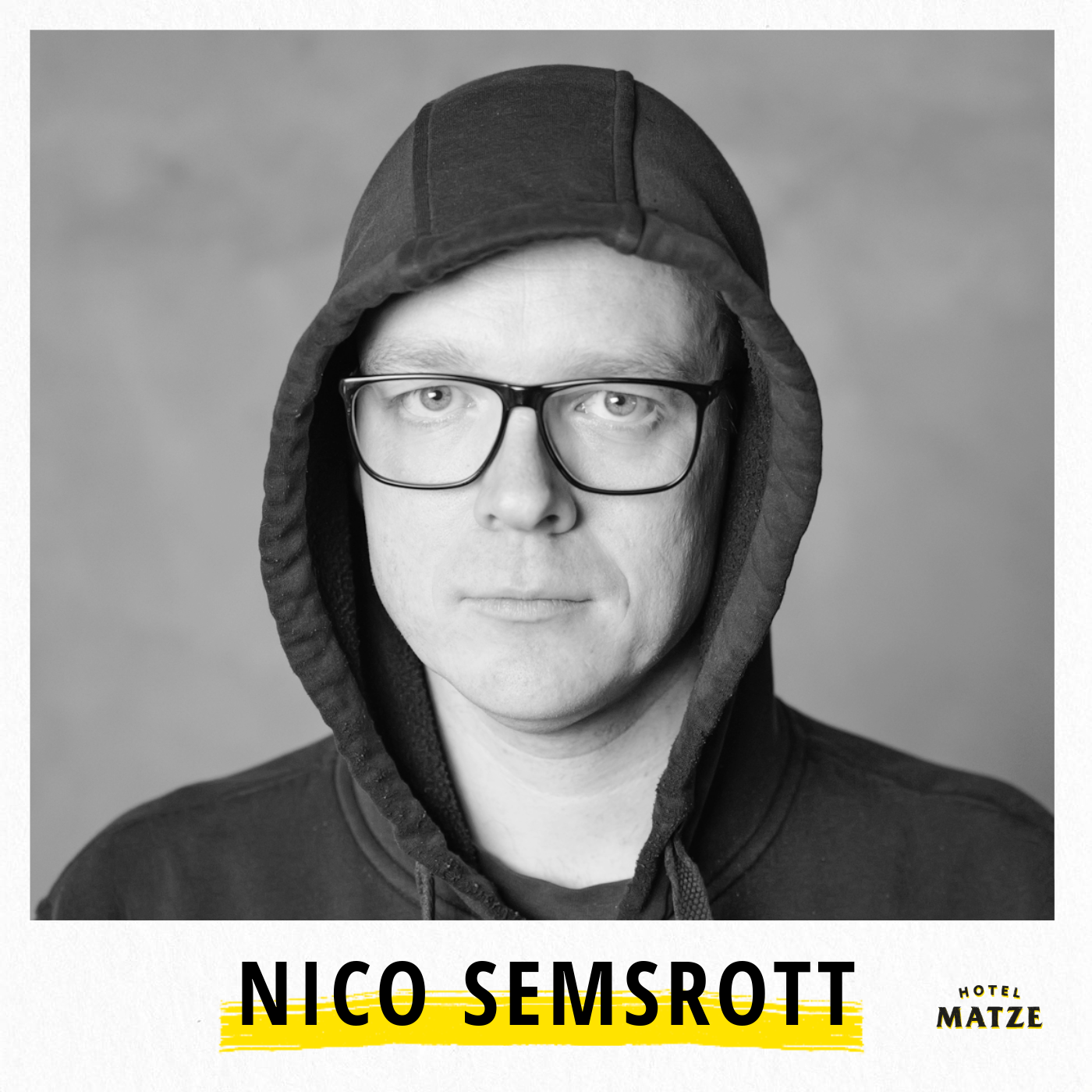 Nico Semsrott - What are politicians actually most afraid of?
From 🇩🇪 Hotel Matze, published at 2026-02-25 16:00
Nico is a satirist and was a Member of the European Parliament for 5 years. I wanted to know from him why he describes Brussels as the least free time of his life, why he identified fear as a key driver in political decisions, and why today he relies on joy against fascism. We talk about self-efficacy, satire, depression, group dynamics, power and powerlessness, and about the question of whether political changes can begin with fun. ADVERTISING PARTNERS & DISCOUNTS: https://linktr.ee/hotelmatze MY GUEST: https://www.instagram.com/nicosemsrott/ THINGS: Nico's Book: https://bit.ly/3ZVsI9Q Fun Facts: https://www.funfacts.de/ CHECK: https://pruef-demos.de/ Georg Schramm: https://bit.ly/4aRXVj2 Chaos Communication Congress: https://events.ccc.de/ Heute-Show: https://bit.ly/4b86BmG Extra 3: https://bit.ly/3N0h2j6 Alexander Stößlein - Production Lena Rocholl - Editorial Mit Vergnügen - Marketing and Distribution MY STUFF: My Question Set FAMILY: https://beherzt.net/products/familie My Question Set LOVE: https://beherzt.net/liebe My First Question Set: https://beherzt.net/matze My Fundraising Campaign: https://machmit.wellfair.ngo/hotel-matze-spendenaktion-2025 My Newsletter: https://matzehielscher.substack.com/ YouTube: https://bit.ly/2MXRILN TikTok: https://tiktok.com/@matzehielscher Instagram: https://instagram.com/matzehielscherHotel LinkedIn: https://linkedin.com/in/matzehielscher/ My Book: https://bit.ly/39FtHQy
-
 The story you're not hearing about AI data centers | Ayșe Coskun
From 🇺🇸 TED Talks Daily, published at 2026-02-25 16:00
The race to build smarter AI is crashing into a physical limitation: the power grid simply can't keep up with the energy demands of data centers. Computer scientist Ayșe Coskun shows how we could turn this problem on its head, transforming AI facilities into virtual batteries that help stabilize the grid and accelerate clean energy. Learn why the technology causing this crisis might be the only thing smart enough to fix it.Learn more about our flagship conference happening this April at attend.ted.com/podcast Hosted on Acast. See acast.com/privacy for more information.
-
 Today's Report - February 25, 2026
From 🇵🇱 Raport o stanie świata Dariusza Rosiaka, published at 2026-02-25 13:51
President of Mexico Claudia Sheinbaum said that calm is being restored in Mexico, there is no threat to the organization of the World Cup finals, and all security guarantees are provided. Meanwhile, police are pursuing 23 convicts who escaped from a prison in Puerto Vallarta, Jalisco state, where on Sunday the Jalisco New Generation Cartel (CJNG) carried out retaliatory attacks after security forces killed cartel leader Nemesio Oseguera Cervantes, known as El Mencho. Gang members set up road blockades, set fire to cars and public utility buildings. More than 70 people died in clashes between the cartel and security forces, including 25 members of the security forces. El Mencho was one of the most wanted gangsters in the world, and his cartel is considered the largest in Mexico.How did Mexican security forces manage to track him down? Why did this operation happen now? Will it contribute to weakening drug gangs in Mexico, or will Mexicans face an increase in violence before the upcoming football World Cup, whose matches are also to be played in the capital of Jalisco state, Guadalajara?Guest: Piotr Chomczyński---------------------------------------------The World State Report is a broadcast that exists thanks to our Patrons, join the fundraiser ➡️ https://patronite.pl/DariuszRosiakSubscribe to the World State Report newsletter ➡️ https://dariuszrosiak.substack.comReport t-shirts and mugs ➡️ https://patronite-sklep.pl/kolekcja/raport-o-stanie-swiata/ [Self-promotion]
-
 Reduce stress from drama, regain focus, the Stanford Neuroscientist way.
From 🇹🇭 Mission To The Moon, published at 2026-02-25 13:00
Nowadays, we live with more drama. As we scroll through our feeds, we constantly encounter stressful, engaging, and infuriating stories, without realizing that these things are slowly draining our energy and focus, little by little. This MM EP. invites us to understand how prolonged consumption of drama affects the brain and body, from the perspective of Andrew Huberman, a neuroscientist and professor of Neurobiology from Stanford School of Medicine, along with simple ways to cope with drama to regain calm and focus without cutting ourselves off from social media. #society #brain #stress #missiontothemoon #missiontothemoonpodcast
-
 Exhaustion at the front in Ukraine
From 🇳🇱 Boekestijn en De Wijk, published at 2026-02-25 12:24
Manpower shortage Russia and Ukraine | Trump's State of the Union | Talks and war preparations Iran Russia and Ukraine are further entangled in a war of attrition in which drones dominate the thirteen-hundred-kilometer front and major breakthroughs fail to materialize. Arend Jan Boekestijn and Rob de Wijk explain how Ukraine advances several kilometers near Hulyaipole, while both armies struggle with personnel shortages, outdated recruits, and a deadly "kill zone" that makes large-scale offensives practically impossible. Russia attempts to mask diplomatic and military setbacks with nuclear saber-rattling and disinformation about alleged British and French nuclear deliveries to Ukraine. The SVR intelligence service, Kremlin mouthpiece Dmitry Medvedev, and state media circulate the narrative, while in Europe concerns grow about Russian sleeper structures and the vulnerability of energy supply via the Druzhba pipeline. Meanwhile, Trump polarizes American politics with harsh migration rhetoric, volatile trade tariffs, and sharp attacks on Democrats. In the Middle East, Iran and the Revolutionary Guard prepare for potential American attacks, while ammunition stockpiles, air defense, and regional escalation make the strategic playing field extra vulnerable to miscalculations. About the Podcast Arend Jan Boekestijn and Rob de Wijk, led by Hugo Reitsma, explore the new world order. What do war, power politics, and economic shifts mean for Europe and the Netherlands? In each episode, they delve into current geopolitical affairs. In 2022, Boekestijn en De Wijk was named the winner in the News & Politics category at the Dutch Podcast Awards Respond? On X: @ajboekestijn and @robdewijk Bluesky: @hugoreitsma.bsky.social Mail: [email protected] About the creators: Arend Jan Boekestijn is a Dutch historian and former politician. He studied history and political science at Vrije Universiteit Amsterdam. Boekestijn is a former Member of Parliament (until 2009). Since 1989, he has been affiliated with the history department of Utrecht University and since 2016, a member of the Peace and Security Committee of the AIV. Rob de Wijk studied contemporary history and international relations, earned his doctorate on nuclear weapons strategies, became a professor in Leiden, and founded the Hague Centre for Strategic Studies in 2007. Hugo Reitsma studied law and political science. He previously worked as a political reporter and from various conflict zones. He is the author of the book ‘Boekestijn en De Wijk predict the future’ (November 2023).See omnystudio.com/listener for privacy information.
-
 Korea 24 - 2026.02.25
From 🇰🇷 Korea 24, published at 2026-02-25 12:00
Korea 24 is a daily current affairs show that covers all the biggest stories coming out of South Korea. Every weekday, Korea 24 brings you the latest news updates, as well as in-depth analysis on the most important issues with experts and special guests, providing comprehensive insight into the events on the peninsula.
-
 ÉRIC AND RAMZY: ALL THE TABOO SUBJECTS HAVE BEEN TACKLED IN THIS VIDEO (JUST HYSTERICAL LAUGHTER)
From 🇫🇷 LEGEND, published at 2026-02-25 10:00
Thanks to Éric and Ramzy for coming on Legend Éric and Ramzy on Legend is a bit like opening their life's photo album… but without blurring out the embarrassing moments! Encounters, family, education, insecurities… they told all, unfiltered, and sometimes a little too much!Find all information about our guests here ⬇️ Find Éric and Ramzy's YouTube channel here ➡️ https://www.youtube.com/@ericetramzyFind Coudy's information here ⬇️His YouTube account ➡️ CoudyHis Instagram account ➡️ https://www.instagram.com/coudy.officielHis TikTok account ➡️ coudy.officiel on TikTokHis Snapchat account ➡️ coudyonline on SnapchatFind the shows mentioned during the interview ⬇️The Conspiracy Theorist ➡️ https://youtu.be/Pe_KJJ6IwBAThe Flat-Earther ➡️ https://youtu.be/vFJAeqcmOzULorant Deutsch ➡️ https://youtu.be/rmySFmONuS0 Find the full interview on YouTube ➡️ https://youtu.be/RKsNrak7VLo For all partnership requests: [email protected] Find us on all LEGEND networks!Facebook : https://www.facebook.com/legendmediafr Instagram : https://www.instagram.com/legendmedia/ TikTok : https://www.tiktok.com/@legend Twitter : https://twitter.com/legendmediafr Snapchat : https://www.snapchat.com/@legendcm75017 Hosted by Acast. Visit acast.com/privacy for more information.
-
 The ICE hiring boom
From 🇺🇸 Planet Money, published at 2026-02-25 08:00
Live event info and tickets hereICE is scaling up, with rapid new hiring. So we ask, has training new officers changed? At what cost? Also, the Trump administration has plans to pour billions of dollars into warehouses for mass immigrant detention centers, which can totally change the economy of some areas. We hear from a rural town in Georgia that wants an ICE facility in its own backyard. These episodes were originally published on Planet Money’s sister daily podcast The Indicator.Pre-order the Planet Money book and get a free gift. / Subscribe to Planet Money+Listen free: Apple Podcasts, Spotify, the NPR app or anywhere you get podcasts.Listen to the Indicator from Planet MoneyFacebook / Instagram / TikTok / Our weekly Newsletter.The episodes of The Indicator were produced by Julia Ritchey, with engineering by Jimmy Keeley. They were fact-checked by Sierra Juarez. Kate Concannon is our show's editor.This episode of Planet Money was produced by Luis Gallo, with help from James Sneed. It was edited by Planet Money’s Executive Producer, Alex Goldmark.Learn more about sponsor message choices: podcastchoices.com/adchoicesNPR Privacy Policy
-
 Super Soul Special: Jay Williams: You Can Survive Your Worst Mistake
From 🇺🇸 Oprah's Super Soul, published at 2026-02-25 07:00
-
 Please Keep Me Anonymous with Sara Pascoe
From 🇬🇧 Sh**ged Married Annoyed, published at 2026-02-25 05:30
The brilliant comedian, podcaster and writer Sara Pascoe joins Chris and Rosie on today's Please Keep Me Anonymous. They discuss Book-Tok, coming to trends late, their first ever stand up kids and how life (and work) changes once you have kids! Sara also reads a very funny story from a SMA! You can catch Sara on tour with her show I Am a Strange Gloop, for tickets visit sarapascoe.co.uk/tickets Sara's podcast Weirdos Book Club which she hosts with Cariad Lloyd is available wherever you get your podcasts and you can even catch them in person at The Crossed Wires Festival. Visit crossedwires.live/podcast/weirdos-book-club for tickets If you want to get involved and have your stories and voice notes included on the podcast then get in touch! 📧: [email protected] 📱: 07874 406650 You can watch the podcast on the Shagged Married Annoyed YouTube channel: youtube.com/@shagged.married.annoyed Learn more about your ad choices. Visit podcastchoices.com/adchoices
-
 MALAWI: Cost of Living Rises & more – 24th Feb 2026
From 🇦🇷 Rorshok Argentina Update, published at 2026-02-25 05:00
A land ownership audit, a new investigation into VP Chilima’s accident, a surge in cholera and fibroids cases, Joyce Mvula’s retirement, African Swine Fever, and much more!Thanks for tuning in!Let us know what you think and what we can improve on by emailing us at [email protected]. You can also contact us on Instagram @rorshok_malawi or Twitter @RorshokMalawiLike what you hear? Subscribe, share, and tell your buds.Who Prosecutes The Prosecutor?: https://www.nyasatimes.com/dpp-powers-under-fire-when-prosecutorial-discretion-becomes-a-democratic-risk/https://mwnation.com/dpp-powers-come-under-scrutiny/https://www.nyasatimes.com/legal-community-slams-dpps-unchecked-powers-after-collapse-of-high-profile-corruption-cases/Rorshok Updates: https://rorshok.com/updates/Check out our new t-shirts: https://rorshok.store/We want to get to know you! Please fill in this mini-survey: https://forms.gle/NV3h5jN13cRDp2r66Wanna avoid ads and help us financially? Follow the link: https://bit.ly/rorshok-donate
-
 #228 A true king?
From 🇩🇪 Mordlust, published at 2026-02-25 04:00
Trigger warning: This episode deals with antisemitism While sitting on a curb outside "The Westin Leipzig" hotel, Gil Ofarim records the video that will go viral the next day. The reason for this is a serious accusation the singer makes against a hotel employee: that he was told he could only check in there if he packed away his Star of David. An antisemitism accusation that quickly made headlines far beyond Germany. However, after reviewing surveillance cameras, doubts arose as to whether the incident really happened as Ofarim described it. When Gil apologized two years later during a defamation trial and reached an agreement with the hotel employee, the case could have been closed. But then in 2026, he enters the jungle and sparks a debate about remorse and resocialization. And about how to deal with someone who tries to rewrite history a second time. This episode of "Mordlust – Crimes and their Backgrounds" deals with a case that shows how dangerous accusations can become when they are spread unchallenged, and what responsibility broadcasters have who profit from offering a platform to people who have incurred guilt. Experts in this episode: Lawyer Linda Pfleger, who attended every day of the trial at the time, lawyer Felix Zimmermann, editor-in-chief of LTO, and Elena Gruschka, pop culture expert and reality analyst **Credit** Hosts: Paulina Krasa, Laura Wohlers Producers: Paulina Krasa, Laura Wohlers and Jon Handschin Editorial Team: Paulina Krasa, Laura Wohlers, Jennifer Fahrenholz and Marysol Mercado Editing: Pauline Korb Legal Review: Abel und Kollegen **Sources (Selection)** Spiegel: https://t1p.de/nzbbf LTO: https://t1p.de/tlsk0 LTO: https://t1p.de/xz7gb Spiegel: https://t1p.de/a2x7g Baumgärtner Friedrich: https://t1p.de/a9r4a Zeit: https://t1p.de/w97em Jüdische Allgemeine: https://t1p.de/r0lux **Episode Partner** Would you like to learn more about our advertising partners? You can find all information & discounts here: https://linktr.ee/Mordlust Would you like to place an advertisement in this podcast? Then find out more about the advertising opportunities at Seven.One Audio here: https://www.seven.one/portfolio/sevenone-audio